

5 Common Epoxy Floor Problems Delaware Valley Homeowners Should Watch For
Epoxy floor problems in the Delaware Valley most commonly include peeling, bubbling, yellowing, hot tire pickup, and moisture-related failures. Each issue traces back to either improper surface preparation, wrong product selection, or ignoring the region's climate demands. Elite Diamond Coatings walks through the causes of each problem and how to prevent them.
That flaking patch on your garage floor isn't just a bad coating. It's usually a surface preparation failure hiding underneath. The Delaware Valley's freeze-thaw cycles and humidity accelerate every weakness in a poorly bonded epoxy system, which is why problems tend to show up faster in our region than in drier climates.
1. Peeling and Delamination
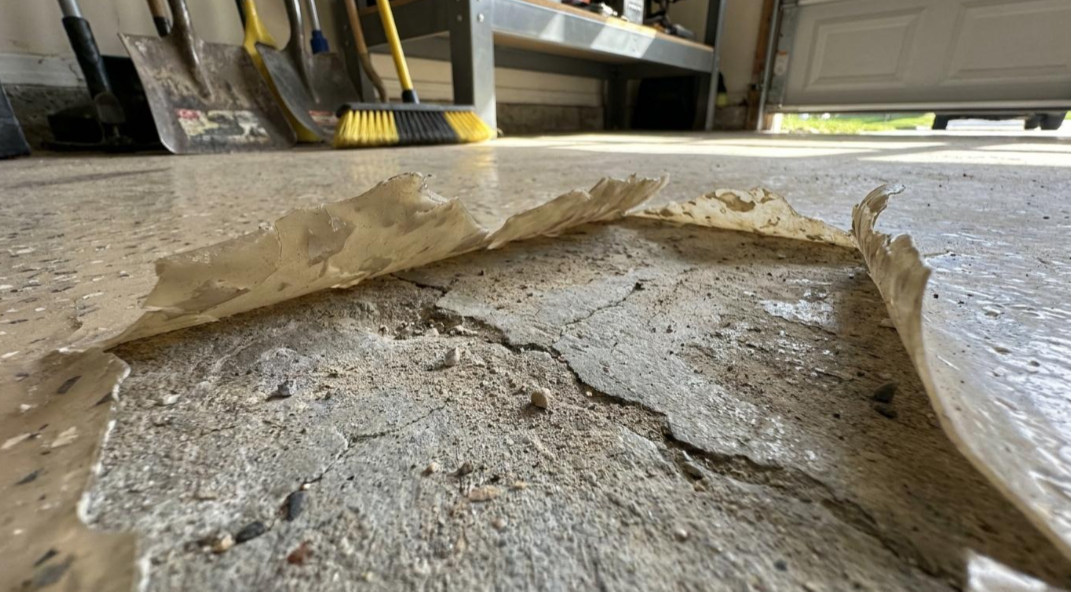
Peeling is the most common epoxy floor problem, and it almost always starts below the surface. When concrete isn't properly profiled before coating, the epoxy sits on top without a mechanical bond. Temperature swings between Delaware Valley winters and summers expand and contract the slab, stressing that weak bond until the coating lifts.
DIY acid-etching creates a clean surface but doesn't open the concrete pores as much as professional diamond grinding does. That's the gap between a coating that peels in year one and one backed by a lifetime warranty.
2. Bubbling and Blistering
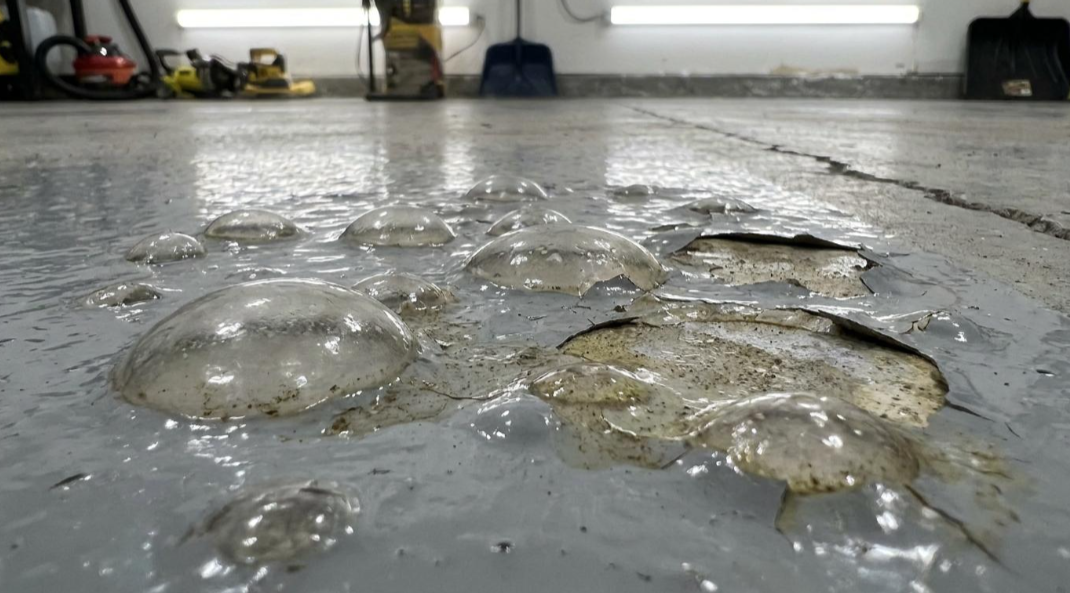
Bubbles form when trapped air or moisture vapor pushes up through the coating before it cures. This happens frequently in Delaware Valley garages where:
- Concrete was damp during application (common after spring rain)
- The coating was applied in direct sunlight, heating the slab and outgassing air from the pores
- No moisture test was performed before installation
A calcium chloride moisture test before coating identifies slabs with excessive vapor transmission. Professional installers test every slab; DIY kits rarely mention this step.
3. Yellowing and Discoloration
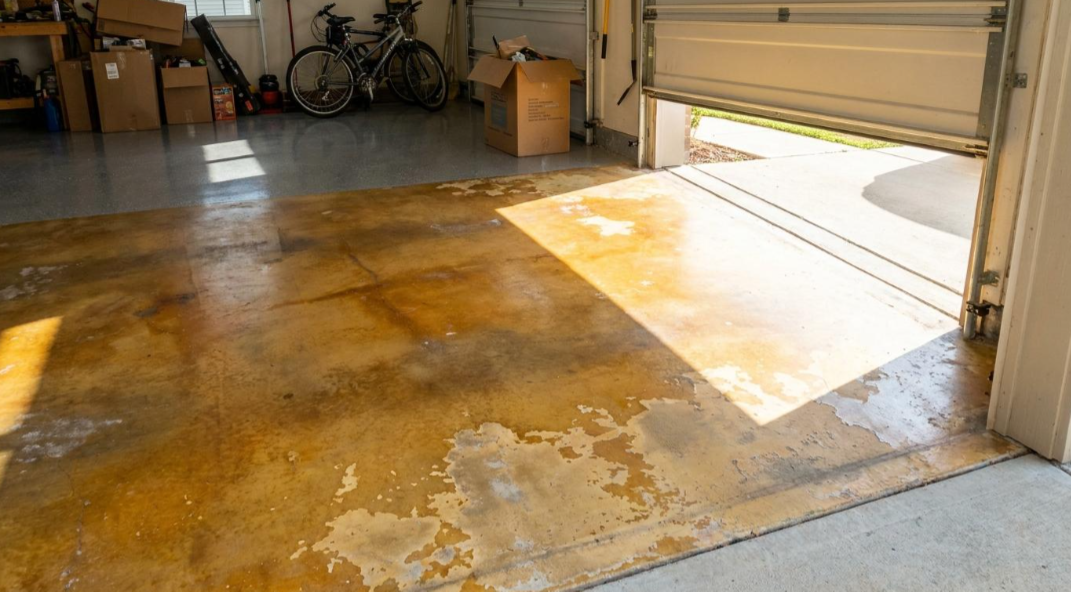
Standard epoxy uses aromatic chemistry that breaks down under ultraviolet light. If your garage door stays open regularly or windows let in direct sunlight, the coating gradually turns amber-yellow. This isn't a defect you can fix with cleaning.
Polyaspartic coatings use aliphatic chemistry that's inherently UV-stable. That's why Elite Diamond Coatings uses polyaspartic as the primary concrete floor coating system for garages with any sun exposure.
4. Hot Tire Pickup
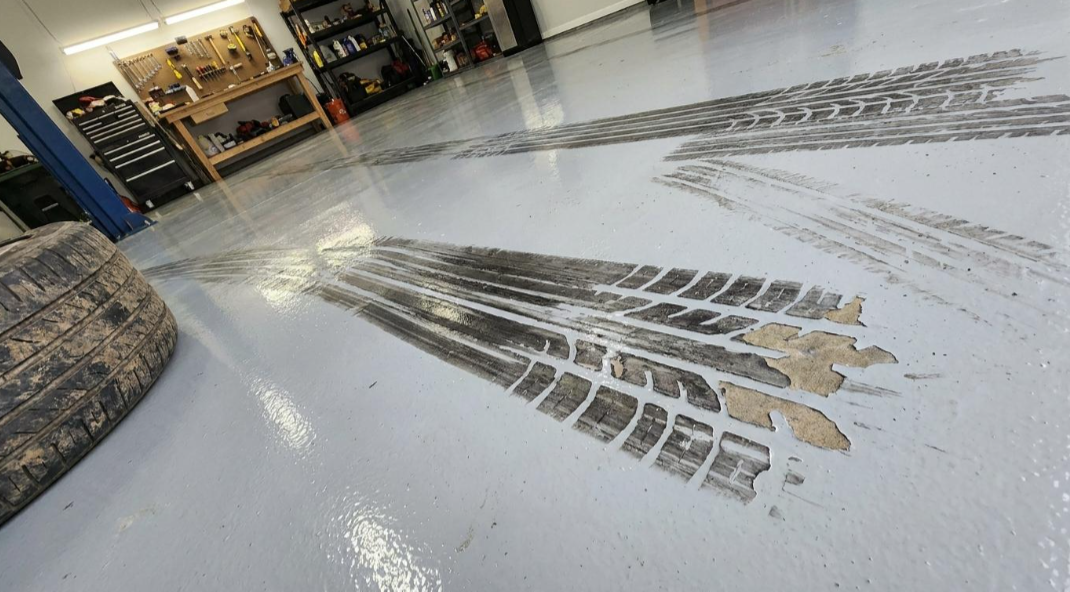
Hot tire pickup occurs when warm tires soften the epoxy surface enough to bond with the rubber. When the tire cools and you drive away, it pulls the coating off in tire-shaped patches. Summer temperatures in the Delaware Valley push pavement temperatures above 130°F, and tires carry that heat directly onto your garage floor.
Higher-quality epoxy systems with polyaspartic topcoats resist hot tire pickup because the topcoat's harder cure profile doesn't soften at the same temperatures. A single-coat DIY epoxy kit has no defense against this.
5. Moisture-Related Failures
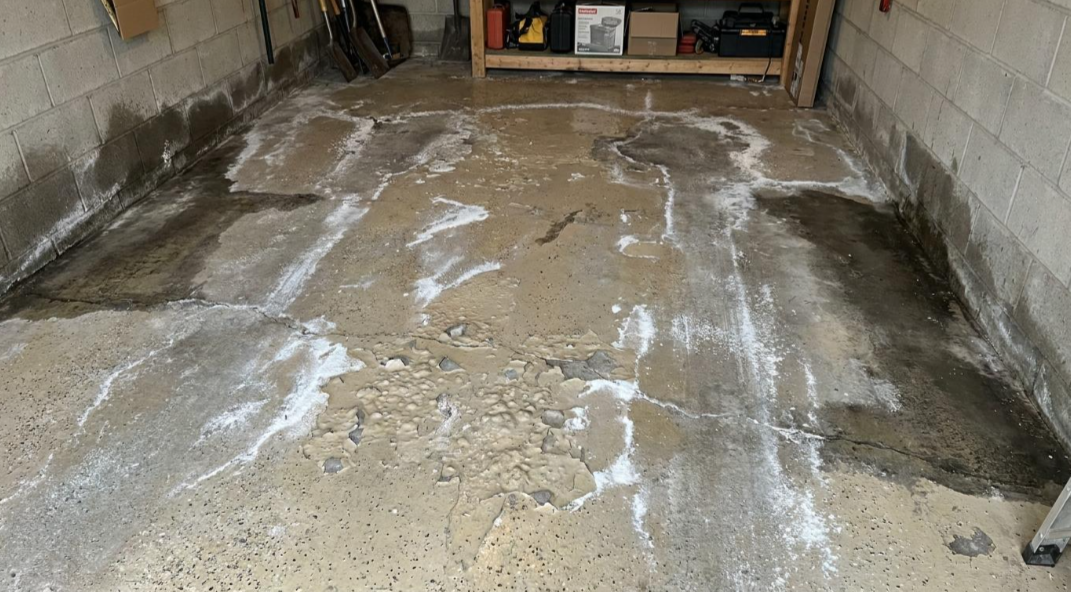
Moisture vapor transmission through concrete slabs is a persistent issue in the Delaware Valley, where clay-heavy soils in Cecil County, Harford County, and Chester County hold groundwater close to the surface. When moisture vapor pushes upward through an unprotected slab, it breaks the bond between the concrete and the coating from below. Elite Diamond Coatings' professional installation process includes moisture testing and vapor barrier application when needed.
Homes built before the 1980s often lack modern vapor barriers beneath the slab, making this problem especially common in older neighborhoods across Bel Air, Havre de Grace, and Wilmington.
Frequently Asked Questions
Can you fix peeling epoxy without removing the entire floor?
Spot repairs over peeling epoxy rarely hold long-term because the bonding failure usually extends beyond the visible damage. A full removal and proper surface preparation is the most reliable path to a coating that lasts. Elite Diamond Coatings diamond-grinds the entire surface to create a new bonding profile.
Why does my epoxy garage floor feel sticky in summer?
Stickiness typically indicates an incomplete cure caused by applying the coating at the wrong temperature or mixing the components incorrectly. Low-quality epoxy kits are especially prone to this in the Delaware Valley's humid summers. Once the cure fails, the only fix is removal and reapplication with a properly formulated garage floor coating.
How do I know if moisture is causing my epoxy floor to fail?
White powdery deposits (efflorescence) along edges or bubbling in random spots often signal moisture vapor transmission from below. Taping a plastic sheet to the bare slab for 24 hours and checking for condensation underneath is a simple field test. Professional installers use calcium chloride testing for precise measurements.
Stop Epoxy Problems Before They Start
Every epoxy floor problem on this list shares a root cause: cutting corners on preparation, product selection, or moisture management. The Delaware Valley's climate punishes those shortcuts faster than most regions. Professional surface preparation, moisture testing, and UV-stable topcoats eliminate the five most common failure modes before they begin.
Schedule a free assessment with Elite Diamond Coatings to find out what your garage floor actually needs before investing in a coating system.